5 Triggers Behind Mom Rage That No One Warns You About + Practical Regulation Tools That Actually Help
Hey mama,
Let me paint you a picture: Your kid asks you for a snack for the fourth time in an hour. You’ve already said no three times. And suddenly, you feel it - that surge of white-hot anger that seems completely disproportionate to the situation. You snap. You yell. And then immediately, the guilt crashes over you.
“What is WRONG with me? Why can’t I just stay calm? Other moms don’t lose it over snack requests.”
As a behavior analyst and mom of four (including twins!) who has personally experienced mom rage, I need you to hear this: there is nothing wrong with you. Mom rage isn’t a character flaw or a sign that you’re a bad mother.
It’s a nervous system response to very real, very specific triggers that most of us don’t even realize are happening.
Today, I’m going to walk you through the five hidden triggers behind mom rage that nobody warns you about - and more importantly, I’m going to give you practical regulation tools that actually work in real life with real kids who won’t give you space to “just breathe deeply.”
What Mom Rage Actually Is (And Isn’t)
Before we dive into triggers, let’s get clear on what we’re talking about.
Mom Rage Is NOT:
• Normal frustration or annoyance
• A character flaw
• Evidence that you don’t love your kids
• Something only “bad mothers” experience
• Uncontrollable or unfixable
Mom Rage IS:
• An intense, overwhelming anger response
• A nervous system reaction to accumulated stress
• Experienced by over 90% of mothers
• Often disproportionate to the triggering event
• A signal that your capacity is depleted
Now let’s talk about what’s really triggering it.
Trigger #1: Nervous System Dysregulation (Not Just “Being Stressed”)
This is the big one that nobody talks about. Mom rage isn’t about being a little stressed - it’s about your nervous system being stuck in a chronic state of activation.
What This Actually Looks Like:
• You startle easily at sudden noises
• You feel constantly on edge, like you’re waiting for the next crisis
• Small disruptions feel like huge threats
• You can’t seem to relax even when you have time
• Your body feels tense and wired even when you’re trying to rest
Why This Triggers Mom Rage:
When your nervous system is chronically activated (stuck in fight-or-flight mode), your brain interprets even minor stressors as threats. That snack request? Your dysregulated nervous system reads it as “another demand I can’t meet” and triggers a survival response - which often looks like rage.
What This Feels Like:
“I feel like I’m always waiting for the other shoe to drop. My body is tense all the time. So when my daughter asks me to help with something while I’m trying to make dinner, it doesn’t register as a simple request - it registers as a threat to my ability to survive the evening.”
The Science Behind It:
Your autonomic nervous system has three states: ventral vagal (calm and connected), sympathetic (fight or flight), and dorsal vagal (shutdown). Mom rage happens when you’re stuck in sympathetic activation with no way to discharge that energy.
Regulation Tools That Actually Help:
Bilateral Stimulation (Works in the moment):
• Cross your arms and tap alternating shoulders rapidly for 30 seconds
• March in place while tapping opposite knees
• Tap alternating thighs while sitting
• This helps discharge fight-or-flight energy quickly
The “Push Against the Wall” Technique:
• Push hard against a wall for 10-15 seconds
• This gives your body a physical outlet for the activation energy
• Can be done anywhere, even with kids watching
Cold Water Reset:
• Splash cold water on your face
• Hold ice cubes in your hands
• Run cold water over your wrists
• Cold activates your vagus nerve and interrupts the rage response
Vocal Release (When you can):
• Go to your car and scream into a pillow
• Hum loudly (humming activates the vagus nerve)
• Make exaggerated sighs or groans
• Physical sound release helps discharge nervous system activation
Trigger #2: Sensory Overload (The Invisible Breaking Point)
This is the trigger that catches most moms off guard because we don’t realize how much sensory input we’re processing constantly.
What This Actually Looks Like:
• Multiple people talking to you at once
• Background noise that never stops (TV, toys, chatter)
• Being touched constantly throughout the day
• Visual chaos from toys, messes, and clutter everywhere
• Smells from diapers, food, and general kid chaos
Why This Triggers Mom Rage:
Your brain can only process so much sensory information before it becomes overwhelmed. When you hit sensory overload, your nervous system essentially short-circuits, and rage is often the result.
What This Feels Like:
One of my clients described it perfectly: “It’s like every sound is turned up to 100. My kids are just talking at normal volume, but it feels like they’re screaming. And then someone touches me and I just… explode.”
The Science Behind It:
Sensory processing happens in your brain’s limbic system - the same area that processes emotions and threat responses. When this area becomes overwhelmed with sensory input, it can trigger emotional dysregulation.
Regulation Tools That Actually Help:
The “Sensory Circuit Breaker”:
• Put on noise-canceling headphones for 2 minutes (yes, even with kids around)
• Tell your kids: “Mom’s ears need a quick break. I’ll be right back.”
• This isn’t ignoring them - it’s preventing a meltdown
Create a “Low Sensory” Zone:
• One corner of one room with minimal visual clutter
• Dim lighting or a lamp instead of overhead lights
• Soft textures
• Go there when you feel overwhelmed building
The “Pressure Reset”:
• Squeeze your hands into tight fists and release
• Press your palms together hard for 10 seconds
• Wrap yourself tightly in a blanket for a minute
• Deep pressure calms an overstimulated nervous system
Announce Your Sensory Needs:
• “I need everyone to use quiet voices for 5 minutes”
• “No touching mom right now - my body needs space”
• “Everyone play in separate rooms for 10 minutes”
• Teaching kids about sensory needs helps them understand
Trigger #3: The Accumulation Effect (Death by a Thousand Paper Cuts)
This is when no single thing is that bad, but the accumulation of small demands, interruptions, and needs creates a rage explosion.
What This Actually Looks Like:
• Being interrupted 47 times while trying to complete one task
• Answering the same question multiple times
• Being asked for things constantly throughout the day
• Never finishing anything you start
• Feeling like you’re constantly being pulled in different directions
Why This Triggers Mom Rage:
Each small interruption or demand uses a tiny bit of your regulatory capacity. By themselves, they’re manageable. But when they accumulate without any opportunity to reset, you eventually hit your limit and explode.
What This Feels Like:
“I wasn’t mad about any one thing. But by 5 PM, I’d been interrupted literally hundreds of times. When my son asked me where his shoe was - a totally reasonable question - I just lost it. It wasn’t about the shoe. It was about being the answer person for EVERYTHING all day long.”
The Science Behind It:
This is called “ego depletion” or decision fatigue. Every decision, every response to a demand, every interruption depletes your self-regulation capacity. Without opportunities to restore that capacity, you eventually run out.
Regulation Tools That Actually Help:
The “Pause Button” Practice:
• When you feel accumulation building, announce: “Mom needs a 3-minute pause”
• Go to the bathroom, lock the door, sit on the floor
• This isn’t avoidance - it’s prevention
Batch Your Availability:
• Set specific times when you’re “available for questions”
• “I’ll answer questions at 3:00 and 5:00”
• Teach kids to write down non-urgent questions
• This reduces constant interruption
The “Demand Dump”:
• Keep a notepad and write down every demand/interruption as it happens
• Seeing them on paper helps you realize why you’re overwhelmed
• Share this list with your partner to show what you’re managing
Create “No Interruption” Signals:
• Wear a specific hat or headband that means “not available unless emergency”
• Use a timer kids can see: “When this goes off, you can ask me things”
• Visual signals work better than verbal ones for kids

Trigger #4: Unmet Needs Stacking Up (Running on Empty)
This is when you’ve been putting everyone else’s needs first for so long that your own basic needs are critically unmet.
What This Actually Looks Like:
• You haven’t eaten a real meal all day
• You’re running on 4-5 hours of broken sleep
• You haven’t had time to use the bathroom alone
• You haven’t had a real conversation with another adult
• Your own basic needs are always last on the list
Why This Triggers Mom Rage:
When your basic physiological needs aren’t met, your body goes into survival mode. In survival mode, your capacity for patience, empathy, and emotional regulation plummets.
What This Feels Like:
“I realized I was screaming at my kids over toys on the floor, and then I realized I hadn’t eaten since breakfast and it was 6 PM. I wasn’t actually mad about the toys. I was hangry, exhausted, and touched out - and the toys were just the breaking point.”
The Science Behind It:
Maslow’s hierarchy of needs isn’t just theory - it’s neuroscience. When basic needs (food, sleep, safety) aren’t met, your prefrontal cortex (responsible for emotional regulation) literally can’t function properly.
Regulation Tools That Actually Help:
The “Emergency Needs Check”:
When you feel rage building, run through this checklist:
• When did I last eat something substantial?
• How much sleep did I get last night?
• Have I had any physical space today?
• When did I last drink water?
The “Non-Negotiable Needs” Protocol:
• Eat something every 3-4 hours, even if it’s just crackers and cheese
• Set an alarm to drink water
• Sit down to eat at least once a day
• These aren’t optional - they’re essential
The “Needs Before Rage” Statement:
Teach your family: “When mom says ‘I need to eat first,’ that means it’s urgent”
• Make it clear that meeting your basic needs prevents everyone from experiencing your rage
• This isn’t selfish - it’s protective
Keep Emergency Supplies:
• Protein bars in your car, purse, and nightstand
• Water bottle that follows you everywhere
• Snacks that require zero preparation
• Remove barriers to meeting basic needs
Trigger #5: Values Violation and Resentment Buildup
This is the hidden trigger that often goes unrecognized: when you’re living in a way that violates your core values, resentment builds until it explodes as rage.
What This Actually Looks Like:
• You value rest but never take breaks
• You value equality but handle 90% of household labor
• You value authenticity but constantly perform “perfect motherhood”
• You value your career but feel forced to sacrifice it
• You value connection but feel completely isolated
Why This Triggers Mom Rage:
When there’s a gap between your values and your reality, it creates internal conflict and resentment. That resentment has to go somewhere, and it often comes out as rage toward the people closest to you.
What This Feels Like:
“I was furious at my kids for making messes, but really I was furious that I was the only one cleaning them up. I was furious that my partner could work uninterrupted while I was constantly managing everything. The mess wasn’t the problem - the inequity was.”
The Science Behind It:
Values violations create cognitive dissonance - the psychological discomfort of holding conflicting beliefs or living in opposition to your values. This internal conflict creates stress that manifests as external anger.
Regulation Tools That Actually Help:
The “Values Check-In”:
When rage shows up, ask yourself:
• What value of mine is being violated right now?
• What am I actually angry about underneath this?
• What would need to change to honor my values?
The “Resentment Inventory”:
• Write down everything you’re resentful about
• Identify which resentments connect to violated values
• Share this with your partner or support person
• Address the root cause, not just the symptoms
The “Boundary Based on Values” Practice:
• Identify your top 3 values
• Set one boundary that protects each value
• Example: If you value rest, boundary might be “No tasks after 8 PM”
• Communicate these boundaries clearly
The “Redistribution Conversation”:
• Have a calm conversation about household labor distribution
• Use data: “I’m handling X, Y, Z. What are you handling?”
• Negotiate a more equitable distribution
• This addresses the root cause of resentment
How These Triggers Work Together
Here’s what makes mom rage so complex: these triggers usually don’t work in isolation. They compound each other:
• Unmet needs (Trigger #4) make you more susceptible to sensory overload (Trigger #2)
• Sensory overload creates nervous system dysregulation (Trigger #1)
• Nervous system dysregulation makes accumulation (Trigger #3) feel unbearable
• Values violations (Trigger #5) amplify all the other triggers
This is why a single regulation tool often isn’t enough. You need to address multiple triggers simultaneously.
Your Personalized Mom Rage Prevention Plan
Step 1: Identify Your Primary Triggers
Over the next week, notice what’s happening when rage shows up:
• What time of day?
• What was happening right before?
• Which of the 5 triggers seems most relevant?
Step 2: Choose 2-3 Regulation Tools
Pick tools that:
• Match your primary triggers
• Are actually doable in your real life
• Don’t require your kids to cooperate
Step 3: Practice During Calm Moments
Don’t wait for rage to practice these tools. Practice when you’re calm so they’re available when you need them.
Step 4: Create Your “Emergency Protocol”
What will you do when you feel rage building?
• Specific physical action (push wall, cold water, bilateral tapping)
• Specific phrase to say to your kids (“Mom needs 2 minutes”)
• Specific place to go if possible
Step 5: Address Root Causes
While regulation tools help in the moment, you also need to address:
• Chronic sleep deprivation
• Lack of support
• Inequitable household labor
• Unmet needs
• Values violations
When Professional Help Is Needed
Please seek professional support if:
• Mom rage is happening multiple times daily
• You’re having thoughts of harming yourself or your children
• Rage is affecting your relationships significantly
• You feel unable to control your rage despite trying these tools
• You’re experiencing other symptoms of anxiety or depression
There’s no shame in needing professional help. Sometimes mom rage is a symptom of deeper issues that need therapeutic intervention.
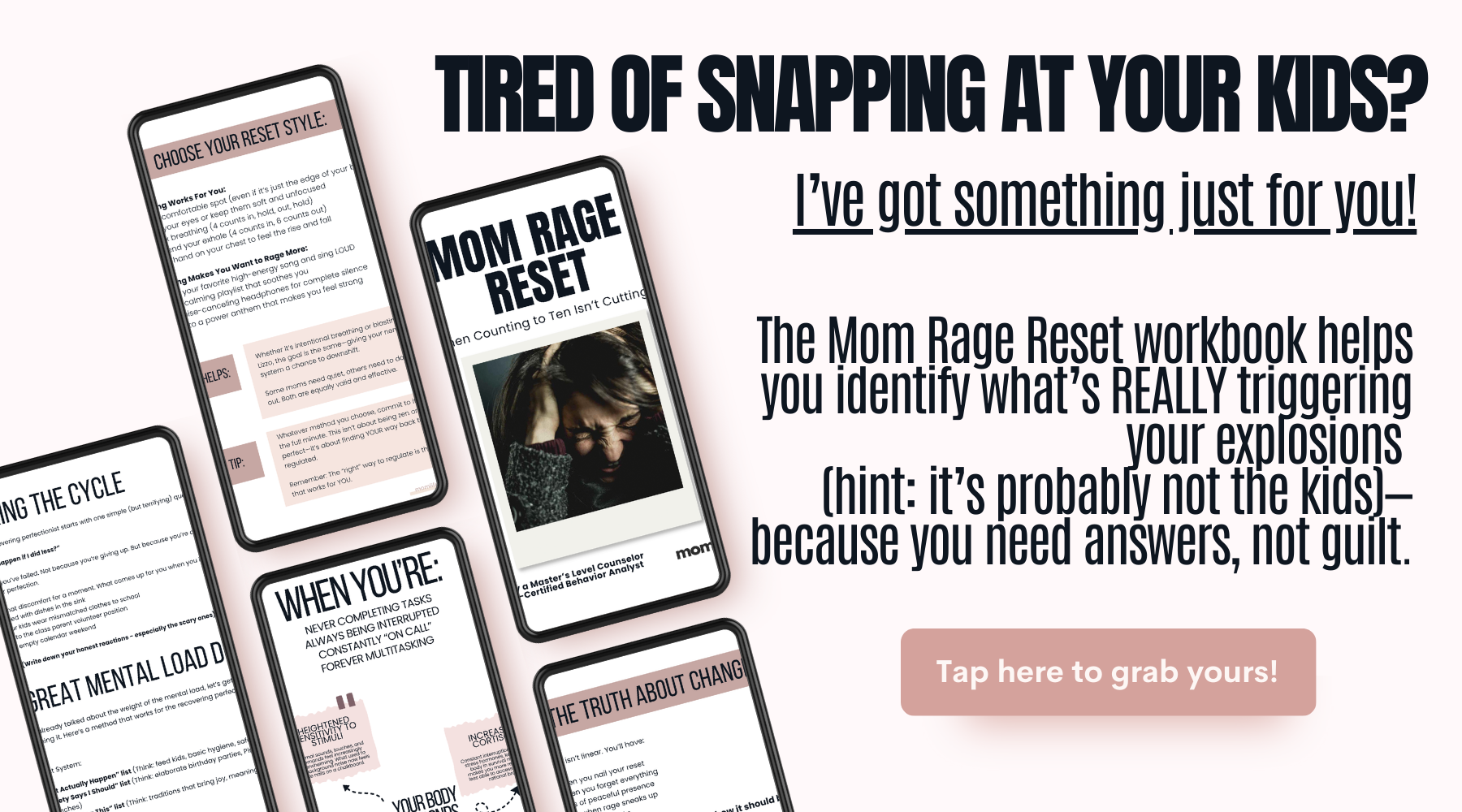
In The Mom Rage Reset Workbook:
You’ll find “What to Say When…” scripts for setting boundaries in common triggering situations, plus Boundary “Permission Slips” to help you overcome the guilt of having limits.
What to Do After a Mom Rage Episode
Immediate Actions:
Separate if needed: Remove yourself from the situation if you’re still activated
Discharge the energy: Use one of the physical regulation tools
Check your basic needs: Eat, drink water, breathe
Repair with Your Kids:
Acknowledge what happened: “Mom got really angry and yelled. That wasn’t okay.”
Take responsibility: “That’s my responsibility to manage, not yours to prevent.”
Explain (age-appropriately): “Sometimes grown-ups get overwhelmed and don’t handle it well.”
Reconnect: Physical affection, eye contact, quality time
Reflect and Learn:
• What triggered this specific episode?
• What warning signs did I miss?
• What could I do differently next time?
• What support do I need?
Moving Forward
Start small. Pick one trigger that resonates most with you. Choose one regulation tool that seems doable. Practice it this week.
You don’t have to fix everything at once. You don’t have to be perfect. You just have to start paying attention to what triggers your rage and having tools ready when it shows up.
Because here’s the truth, mama: you deserve to feel regulated. Your kids deserve to have a mother who isn’t constantly on the edge of explosion. And your family deserves to experience you when you’re not running on empty.
The rage isn’t who you are. It’s what happens when you’re depleted beyond capacity.
Let’s work on building that capacity back up.
Ready to understand what your mom rage is really telling you and get practical tools that actually work? The Mom Rage Reset workbook gives you the same strategies I use with my 1:1 coaching clients - trigger tracking, emergency interventions, and recovery plans for real mom life. Get instant access for $37 and start managing your rage today.
GET THE MOM RAGE RESET WORKBOOK - $37
Need more personalized support? Try 24 hours of FREE coaching and experience what it’s like to have expert guidance tailored to your specific situation.
Try 24 hours of FREE coaching with me - because you don’t have to figure this out alone.
Let’s talk about REAL Motherhood
Discover how we can work together to make decision-making feel less overwhelming.








Follow me on Social @mom_reset_coach